The Displacement Ventilation System (DVS / DV), also known as Thermal Displacement Ventilation (TDV), is a form of cool air distribution that is currently gaining significant attention. Besides helping to elevate the cleanliness within air-conditioned rooms due to the airflow pattern that differs from traditional mixing air systems (as shown in Figure 1), it also significantly reduces investment costs and operating expenses. This article will discuss the details of the Swirl Induction Type (SWIT) displacement ventilation system, which is the latest type of displacement cooling system developed continuously from traditional displacement ventilation systems. Additionally, this article presents real case studies from Thailand concerning the installation and use of this SWIT system.
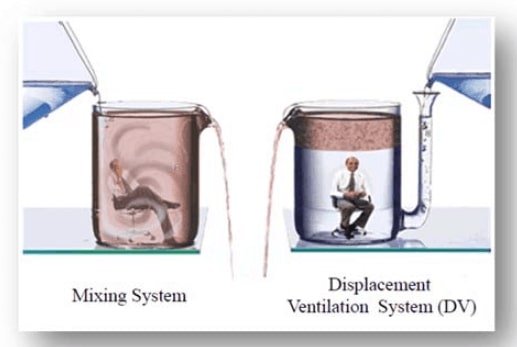
Picture 1 : Compare the airflow patterns under a replacement chilled air distribution system.
(Displacement Ventilation System) and Normal Type (Mixing Air System)
The displacement ventilation system uses cool air supply directly to the area that needs air conditioning from devices or cool air ducts installed at the same level as the area being conditioned (or at floor level). It relies on the natural upward buoyancy of the warmer return air, which passes through the return air grill located at the upper part of the room, returning to the air handling unit (AHU) or fan coil unit (FCU) for further conditioning. This is shown in Figure 2, which differs from conventional air conditioning systems that are mixing air systems. In mixing air systems, supply air diffusers or cool air delivery devices are installed on the ceiling or upper area of the space needing conditioning. They utilize air supply ducts from the AHU or FCU to the air grill to deliver cool air to the area needing conditioning, as illustrated in Figure 3
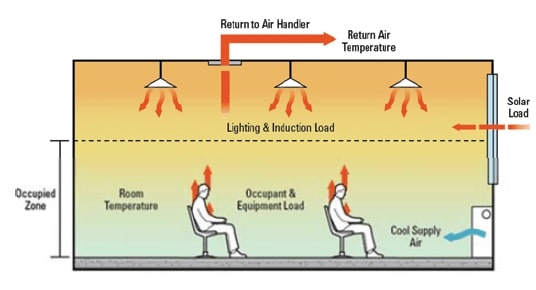
Picture 2 : Displacement Ventilation System
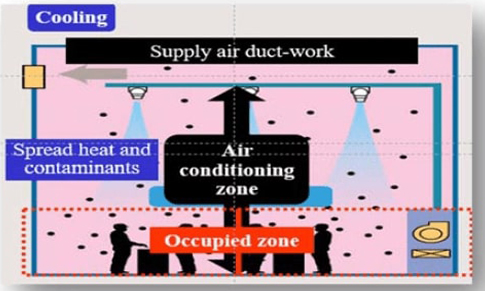
Picture 3 : Mixing Air System
The Swirl Induction Type HVAC system, which is a type of air-cooling distribution system, operates on the same principle as conventional air-distribution systems (as shown in Figure 4), except for the unique manner in which cool air is delivered into the conditioned space. This system utilizes a swirling induction method via specially designed air outlet grilles, as depicted in Figure 5. This principle results in the cool air supplied from the air outlets exhibiting a swirling pattern, which enhances the mixing rate between the supplied cool air and the room air that requires conditioning. Consequently, this leads to a uniform temperature distribution throughout the room at a given height, and the desired room temperature is achieved more quickly compared to conventional air distribution systems illustrated in Figure 6.
Picture 4 : SWIT System
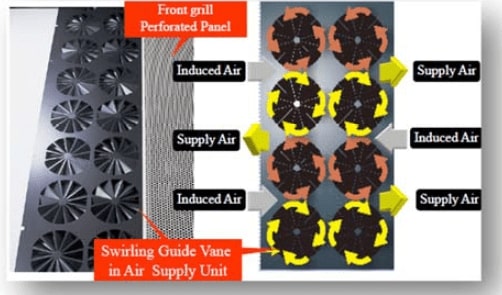
Picture 5 : SWIT Air Grill
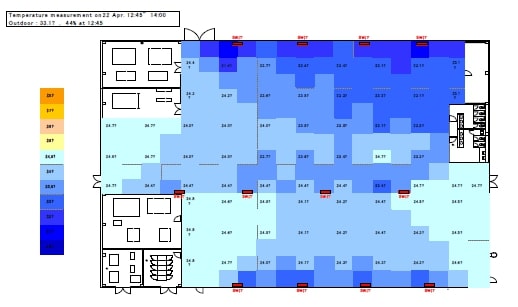
Picture 6 : An example of a temperature distribution chart that is relatively consistent from the SWIT cooling air supply system.
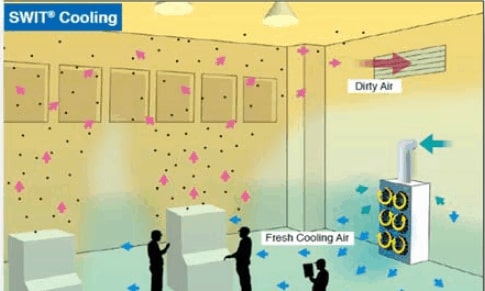
Due to the SWIT System's principle of air displacement, the cool air supplied to the room directly replaces the existing hot air within the room (Directly supply to occupied zone) without needing to pass through unused areas first. This results in the temperature of the cool air at the supply outlet being higher, at 17-18°C, compared to conventional air distribution systems that use Mixing Air, where the temperature of the cool air at the supply outlet is 12-13°C (which is colder and more energy-consuming). This is to achieve the same room temperature of 24-25°C. Additionally, the principle of directly replacing the existing hot air with cool air means that the area considered for cooling load calculation for the SWIT System only covers the actual occupied zone. This zone has a lower cooling height compared to conventional Mixing Air systems, resulting in a reduced room volume for cooling load calculation. Therefore, the SWIT System can effectively reduce the cooling load to a certain extent. Furthermore, the SWIT System helps improve the cleanliness level within the room compared to conventional air distribution systems that use Mixing Air. The principle of directly supplying cool air to the desired area means that the replaced hot air helps carry away small dust particles present in the room air, as shown in Figure 7.
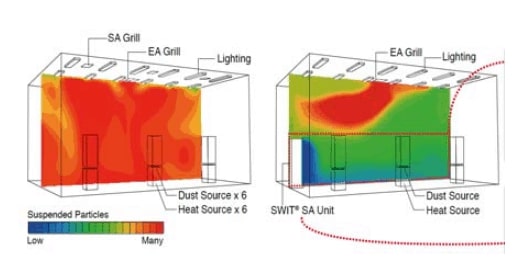
Picture 7 : Comparison of the distribution of small particles (Suspended Particles) within a room equipped with a Mixing Air cooling system (left) and a SWIT system (right).
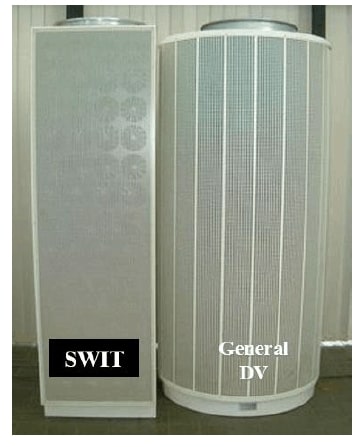
Picture 8 : Comparison of the size of air supply cool masks using swirling air replacement (SWIT) and general replacement (General DV)
In terms of size and installation area, it was found that the SWIT dispenser is smaller and requires less installation space, with an area of only 1/3 (33%) and necessitating only half (50%) of the installation area required by the conventional dispenser (General DV) as shown in Figure 8.
The rotating vortex cooling air distribution system also helps to deliver cool air over much greater distances. According to tests at an air supply speed not exceeding 1 meter/second, it was found that the rotating vortex cooling air distribution system can deliver cool air up to 30 meters, provided there is no excessive exhaust air and internal heat sources.
Copyright © www.thaitakasago.co.th, All Right Reserved.